← Guides · Home & plots · Dome
Growing edible mushrooms at home
Oyster mushrooms on coffee grounds, shiitake on logs and wine caps in the garden bed. Clear steps, a conditions table and food safety. Only grow species you bought as identified spawn.
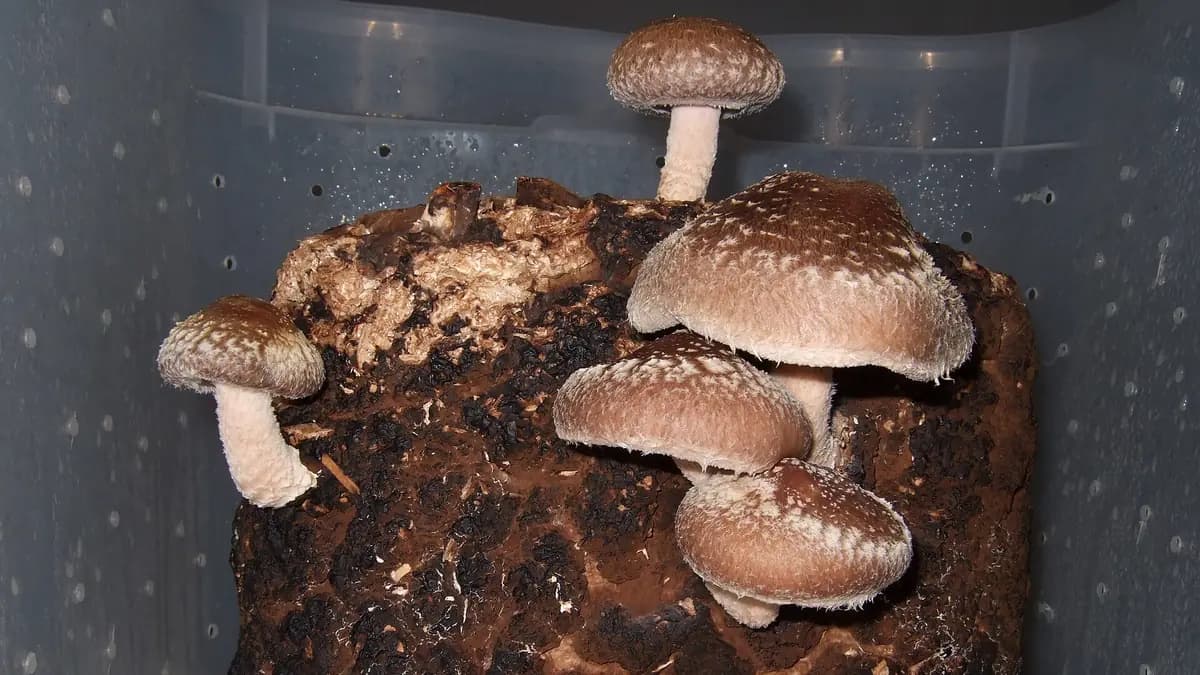
Why mushrooms are an easy start
- Mushrooms need no grow lights and no soil: they fruit from a substrate colonised by mycelium. Indirect light is enough.
- Oyster mushrooms are fast and tough: they colonise the substrate aggressively and give a harvest roughly 1–2 months after starting.
- Log cultures (shiitake, oyster) mostly need moisture and shade after inoculation – and yield for several years.
- Household coffee grounds and straw work as oyster substrate. Spent substrate goes to compost or mulch.
Species for beginners
Start with oyster mushrooms. Once that works, try shiitake on logs or wine caps in the garden.
| Species | Difficulty | Substrate | Where | Notes |
|---|---|---|---|---|
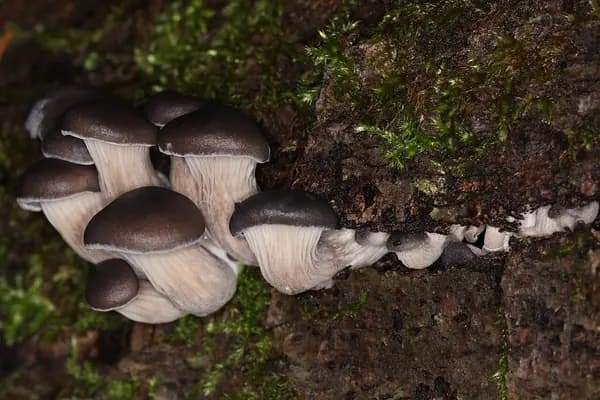
| Oyster mushroom (Pleurotus ostreatus) | Easy | Coffee grounds, straw pellets, chopped straw, hardwood logs | Indoors all year; logs outdoors | Fastest. Sporeless strains are sold (less spore dust indoors). |
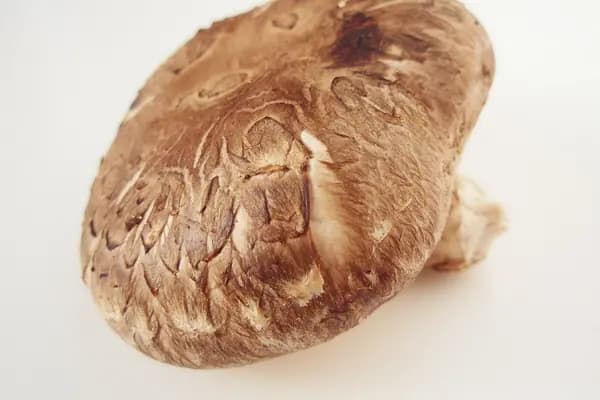
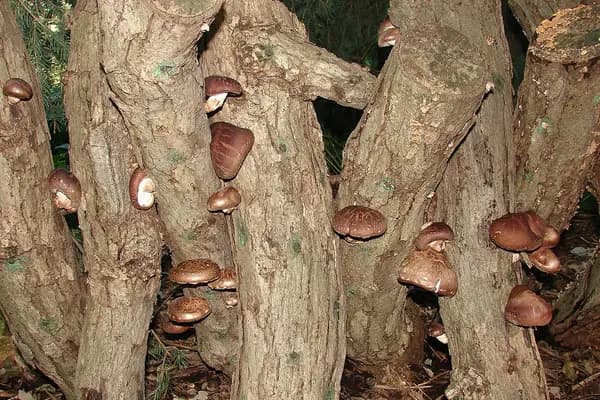
| Shiitake (Lentinula edodes) | Medium | Fresh hardwood logs (e.g. birch, alder, oak, maple) or sawdust blocks | Logs outdoors in shade; blocks indoors | A log fruits about 6–18 months after inoculation, for several years. Always eat cooked. |
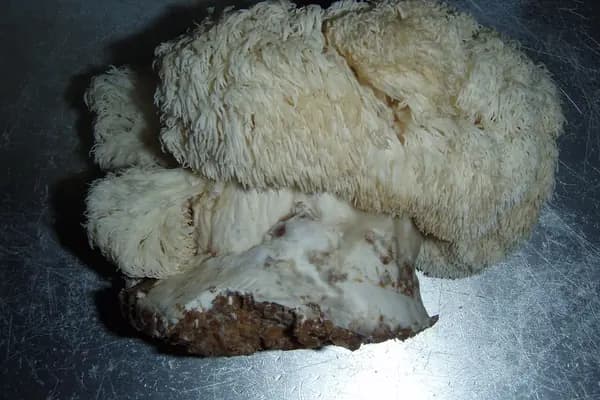
| Lion's mane (Hericium erinaceus) | Medium | Hardwood sawdust blocks, logs | Indoors as a block | Finnish name siiliorakas. The fruiting body is not a novel food in the EU, so the edible mushroom is allowed; buy it as cultivated spawn or a kit. |
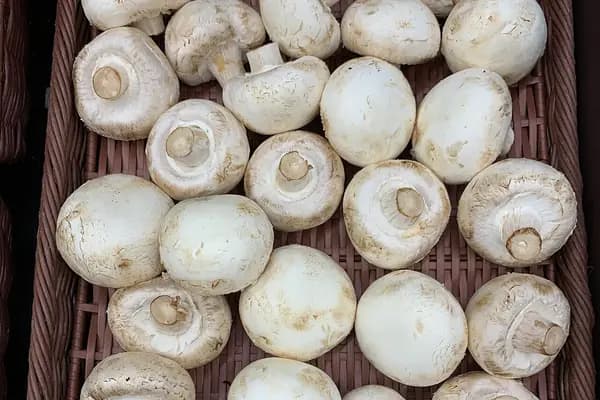
| Button mushroom (Agaricus bisporus) | Hard | Pasteurised mushroom compost + casing layer | Indoors, cool | Needs special compost and tight conditions; at home mainly as a ready kit. |
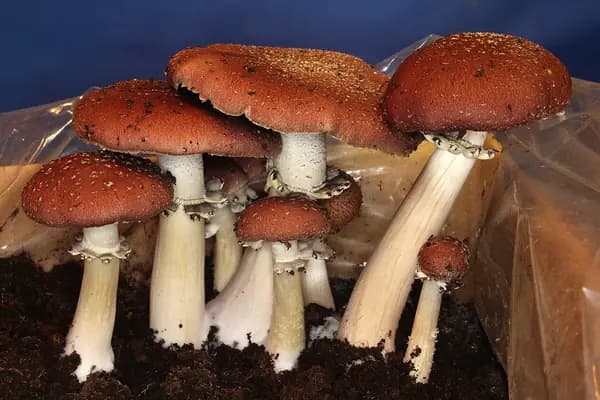
| Wine cap (Stropharia rugosoannulata) | Easy outdoors | Fresh hardwood chips or straw | Vegetable garden, under berry bushes, part shade | Not the same species as the verdigris agaric (Stropharia aeruginosa). |
| Oyster mushroom on logs | Easy | Fresh hardwood logs (not conifer) | Outdoors in shade | Colonises a log in about 3–6 months, fruits for several years. |
Ready kit or spawn + your own substrate?
| Option | Good for | Price (approx., 2026) | Typical yield |
|---|---|---|---|
| Ready grow kit (pre-colonised bag/box) | First try – open, mist, harvest | about €17–18 | 200–400 g, 1–2 flushes |
| DIY kit (spawn + straw pellets + bag) | When you want to do it from scratch | about €15 | about 600–900 g |
| Reusable grow box + spawn + pellets | Continuous growing, also with coffee grounds | about €25 | up to about 600 g per fill |
| Spawn bag only (for coffee grounds) | Your own container | about €10 | depends on the fill |
| Large grow bag (about 20 l) | Cellar, cool dome/greenhouse, autumn balcony (10–20 °C) | about €40 | up to about 3 kg |
| Mushroom dowels for logs (shiitake, oyster) | Outdoor culture in the garden or at the cottage | about €10 / 50, €20 / 100 dowels | 100 dowels cover about 2–3 m of logs; yields for years |
- Where: Finnish mushroom farms and their web shops, health-food and garden stores, and grow shops. Prices were checked from Finnish mushroom farms' web shops (see sources).
- Buy spawn from a supplier that states the scientific species name. Unopened spawn keeps a few months in the fridge.
Prices vary and are approximate.
Cleanliness, pasteurisation and sterilisation – basics
- The main enemy is green mould (Trichoderma). Wash your hands and disinfect containers, spoon and knife with boiling water or 70 % alcohol.
- Pasteurisation reduces competing microbes: keep straw in 65–75 °C water for 1–2 hours. Straw pellets are wetted with boiling water, which also pasteurises them.
- Sterilisation (pressure cooker, about 121 °C) is needed for nutrient-rich sawdust and grain substrates – beginners should buy these ready-made.
- Cool the substrate below 30 °C before adding spawn, otherwise the mycelium dies.
- Keep the bag or container closed during colonisation; air passes through the filter patch or breathable tape.
Step by step: oyster mushrooms on straw pellets or straw
You need: oyster spawn, straw pellets (or chopped straw), a grow bag with a filter or a lidded container + breathable tape, boiling water and a clean spoon.
- Wash your hands and disinfect the bag/container and spoon with boiling water.
- Pour boiling water over the pellets (about 1.5–3 l per kg, as the supplier says) and stir until they fall apart. Straw can be pasteurised in 65–75 °C water for 1–2 h and drained.
- Let it cool below 30 °C (often 2–8 h), covered.
- Crumble the spawn and mix it evenly through – about 5–10 % of the substrate weight.
- Pack lightly and close the bag, leaving the filter free (or cover the container's 10–15 mm holes with breathable tape).
- Colonisation: 20–25 °C, out of direct sun, about 2–3 weeks until the substrate is white throughout.
- Cut a 5–10 cm X with a disinfected knife and move the bag somewhere cooler (15–20 °C) and bright, not in direct sun.
- Keep the cut moist: mist 2–3 times a day or put an airy humidity tent (a bag with holes) over it.
- Harvest when the edges of the largest caps start to flatten – usually 5–7 days after pins appear. Twist the whole cluster off at the base.
- Keep it moist: a second, often smaller flush follows in 2–4 weeks. Spent substrate goes to compost or mulch.
A small DIY bag typically yields about 0.6–0.9 kg of fresh mushrooms.
Step by step: oyster mushrooms on coffee grounds
You need: spawn, a tight lidded plastic container (about one 15 mm hole per 1.5 l, covered with breathable tape) and fresh coffee grounds.
- Disinfect the container, lid and spoon with boiling water.
- Mix the spawn into 1–3 filters' worth of fresh, cooled drip or French-press grounds (no more than about 12 h old). Espresso grounds are too dry – add a splash of water.
- Keep at 19–23 °C with the lid closed. No light needed.
- Add fresh grounds on top every 3–5 days whenever the previous layer is covered by white mycelium. Don't stir.
- When the container is full, move it somewhere cooler (below 20 °C) and bright. Mushrooms push the tape aside, usually within 4–8 weeks.
- Mist the mushrooms or the inside of a humidity tent 2–3 times a day; harvest the whole cluster at once.
Yellow or orange liquid is enzymes from the mycelium – normal.
Step by step: shiitake on logs
You need: fresh hardwood logs (e.g. birch, alder, oak or maple, about 8–20 cm thick and 60–100 cm long), shiitake dowels, a drill with the bit size the dowel supplier specifies, a hammer and beeswax or food-grade wax.
- Inoculate within 1 day – 3 weeks of felling (fresher is better); logs felled in winter can wait in the shade until spring.
- Drill holes about 10 cm apart in rows, rows offset (diamond pattern), as deep as the dowels.
- Tap the dowels in and seal each hole with hot wax so the mycelium doesn't dry out.
- Colonisation 6–18 months: logs in shade (about 80 % shade), off the ground, out of the wind. Keep log moisture above 30–35 %: water or soak for at most 2 h in dry spells.
- When white mycelium shows on the log ends, force a flush: submerge the log in cold water for 12–24 hours and stand it upright.
- Pins appear in 3–5 days and the harvest in 7–14 days after forcing. Pick before the caps flatten.
- Rest the log 6–8 weeks before forcing again. A log typically produces for 3–5 years.
The same method works for oyster mushrooms on logs – faster (about 3–6 months) but usually not as precisely forceable.
Outdoors: wine caps in the garden and logs in the yard
- Wine cap: in part shade lay cardboard, then layers of fresh hardwood chips or straw and spawn about 15–30 cm deep, with chips on top. Water regularly.
- Best time to start is May–September; a spring bed can fruit the same summer or autumn, an autumn bed usually the next year. Top up with chips in spring and autumn.
- Wood-decay fungi don't spread into the soil outside their substrate; the decomposed bed is a good soil improver.
- In a dome or greenhouse: logs and straw bags like shade and moisture, but in heat (above 25–30 °C) move them somewhere cooler.
Conditions by stage
Colonisation = the mycelium takes over the substrate. Fruiting = mushrooms grow.
| Species and stage | Temperature | Humidity | Fresh air / CO₂ | Light | Duration |
|---|---|---|---|---|---|
| Oyster – colonisation | 20–25 °C (substrate not above 30 °C) | Closed bag, about 80–90 % | Little: filter or tape is enough | Not needed | 2–3 wk (straw); coffee grounds fill in 4–8 wk |
| Oyster – fruiting | 15–20 °C | 85–95 % | Plenty of fresh air (roughly CO₂ below about 1000 ppm) | Indirect light 10–12 h/day | 5–7 days from pins to harvest; next flush 2–4 wk |
| Shiitake log – colonisation | Log temperature best 22–25 °C | Log moisture above 30–35 % | Outdoors, ventilated shady spot | Shade (about 80 %) | 6–18 months |
| Shiitake log – fruiting | Depends on strain, typically about 12–24 °C | High, about 80–90 % | Outdoor air | Indirect light | 7–14 days after forcing; rest 6–8 wk |
For other species (lion's mane, button mushroom) follow the spawn supplier's instructions.
🍄 Species for home growing: more details
Species details for home growing (in Finnish). Every figure comes from a source; if a source has no exact value, we say so.
Oyster mushroom Pleurotus ostreatus, P. pulmonarius ym.
King oyster mushroom Pleurotus eryngii
Shiitake Lentinula edodes
Lion’s mane Hericium erinaceus
Button mushroom and portobello Agaricus bisporus
Maitake (hen-of-the-woods) Grifola frondosa
Sources
- University of Arizona Extension, Backyard Gardener #107: Growing edible mushrooms (PDF)
- UF/IFAS EDIS SS662: D.I.Y. FunGuide – grow your own oyster mushrooms at home
- Moonmoon ym. 2010, Saudi J Biol Sci 17(4): Cultivation of different strains of king oyster mushroom (Pleurotus eryngii) on saw dust and rice straw in Bangladesh (PMC)
- USDA Agroforestry Note 13: Farming exotic mushrooms in the forest (PDF)
- Cornell Small Farms: Forcing bolts (shiitake)
- Cornell Small Farms: Shiitake mushroom basics
- Cornell Small Farms: Lion's mane – a new candidate for forest mushroom cultivation
- Penn State Extension: Basic procedures for Agaricus mushroom growing
⚠️ Harvest, storage and food safety
- Only grow and eat species you bought as identified spawn from a reliable supplier.
- If other mushrooms appear on a log, bed or bag, don't eat them unless you are completely sure of the species. Deadly poisonous mushrooms grow in Finland, such as the destroying angel, death cap and deadly webcap.
- Always eat shiitake cooked: raw or undercooked it can cause shiitake dermatitis (an itchy rash).
- Store mushrooms in the fridge (+2…+6 °C) in a paper bag and use within a few days, or dry/fry and freeze. Use a separate cutting board and wash your hands.
- Spore allergy: cultivated mushrooms (oyster, button, shiitake) can cause respiratory allergy. Indoors, harvest before the mushrooms shed spores, ventilate, don't grow in the bedroom, and wear a respirator (FFP2) for larger grows. Consider a sporeless oyster strain.
- If you suspect mushroom poisoning in Finland, call the Poison Information Centre: +358 9 471 977.
This guide covers edible mushrooms only. Growing psychoactive mushrooms is not covered.
Common problems
| Problem | Likely cause | Fix |
|---|---|---|
| Green mould (Trichoderma) | Contamination, old coffee grounds, poor pasteurisation | Small patch: remove with a disinfected spoon and add fresh substrate. A lot of mould: bin it and restart more cleanly. |
| Pins dry out, caps crack | Dry indoor air, radiator or ventilation nearby | Mist more often, use an airy humidity tent, move away from heat sources. |
| Long stems, small caps | Too much CO₂ (too little fresh air), often also too little light | Ventilate, make holes in the tent, add indirect light. |
| No mushrooms after 4–8 weeks | Too warm or the container isn't full | Fill it, move it somewhere cool for a few days (e.g. 5–15 °C, not freezing) and keep it moist. |
| Mushrooms grow inside the container | Fresh grounds were added too rarely | Pick off the pins and keep filling until the container is full. |
| Shiitake log doesn't fruit | Not fully colonised yet or the log has dried | Wait for mycelium on the log ends, soak and force with cold water. |
| Small flies | Fungus gnats are attracted to open substrate | Keep tape and lids closed, harvest on time, use a sticky trap. |
This guide is general information for home growing. Always follow the spawn supplier's instructions. Only eat mushrooms that grew from spawn you bought and that you can identify with certainty.
Sources
- Ruokavirasto – Viljellyt ruokasienet
- Ruokavirasto – Sienten käsittely (tunnistus, säilytys, myrkylliset lajit)
- Ruokavirasto – Sienten aiheuttamat haitalliset reaktiot (allergia, siitakedermatiitti)
- Luke – Sientenviljely biotalouden toimenpiteenä (SieVi-hanke)
- Luke Jukuri – Pellavapohjaisen kasvualustan soveltuvuus viljelysienten kasvatukseen
- UF/IFAS Extension – D.I.Y. FunGuide: Grow Your Own Oyster Mushrooms at Home (SS662)
- Penn State – Specialty mushrooms: production technology
- Cornell Small Farms – Four methods of commercial cultivation (straw, pasteurisation)
- Cornell Small Farms – Shiitake cultivation best management practices (PDF)
- Cornell Small Farms – Forcing bolts
- Ohio State University Extension – Shiitake Mushroom Production: Logs and Laying Yards (F-41)
- European Commission – Novel food status consultation (Hericium erinaceus)
- Suomen Lajitietokeskus – Hericium erinaceus (siiliorakas)
- Helsieni – Growkit-ohjeet (kahvinporot, olkipelletit, vihreä home)
- Helsieni – Sienitapit ja pölkkyviljely
- Helsieni – verkkokauppa (hinnat: setit, rihmasto, tapit, kasvatussäkki)
- Satohuone – DIY-kasvatussetti ja ohjeet (itiötön osterivinokas)
- Satohuone – Grow Kit -kasvatusopas
- Mycoboutique – Wine cap (Stropharia rugosoannulata) cultivation